fcgov.com logo
fcgov.com print logo
FCGov.com logo holder
image of fort collins
Snow and Ice Control

Snow Preparations
When Snow Begins
Snow Routes
Additional Services
Sidewalk Snow Removal
Snow FAQs

Program Mission
This program funds personnel, equipment, and materials needed to protect the health and safety of the community by maintaining our public roads and right-of ways during the winter season. Snow and Ice Control encompasses plowing and deicing streets on the City’s designated snow routes and additional services including ice removal, sidewalk plowing and downtown snow removal.

Program Analysis
The snow removal budget is based on the average annual snowfall and plowing and deicing 540 lane miles of prioritized streets. The Master Snow Plan includes the following street priorities, which will be maintained except under extreme conditions.

  • Priority 1: Major arterials considered to be the minimum network which must be kept open to provide a transportation system connecting hospitals, fire stations, police stations, and rescue squad units. Collectively, Priority 1 streets make up the Snow Emergency Route.
  • Priority 2: All remaining arterials and selected collectors completing the network covering the major traffic volume streets.
  • Priority 3: All remaining collectors, bus routes, and access to schools.
  • Priority 4: Streets primarily located in residential areas. Priority 4 streets are plowed only when snow accumulations completely block traffic movement, or when a Snow Emergency has been declared.

Snow Preparations
Although weather can be unpredictable in Colorado, the technology of today allows us to react and respond quickly to winter storm systems. In Fort Collins, there are on average 14-16 storms per year. Before the first snowflake even falls, snow-fighting techniques are reviewed with equipment operators and all snow removal equipment is tested and prepared. Snow route maps are revised each year to take into account increased traffic volume, new schools and annexations. Snow routes are also test-driven to identify hazards possibly hidden by snow in later situations.

Using advanced weather monitoring systems and pavement sensors, the Streets Department is prepared 24 hours a day during the winter snow season. When snow is forecast, operators will mount plows on dump trucks in preparation. Thanks to thorough training and established routes, snow-fighting equipment is generally on the street within 30 minutes after notification begins.

When Snow Begins
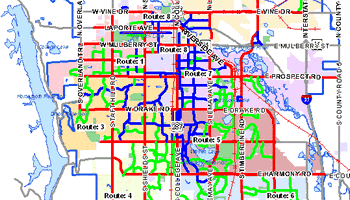
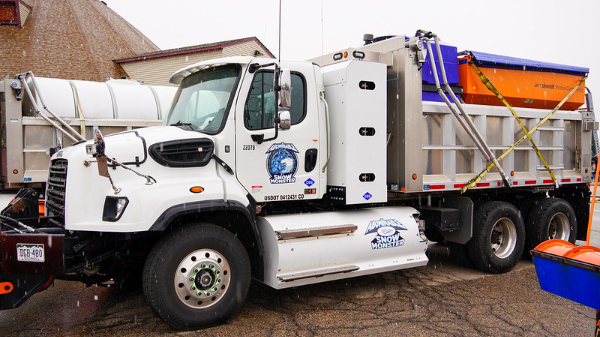
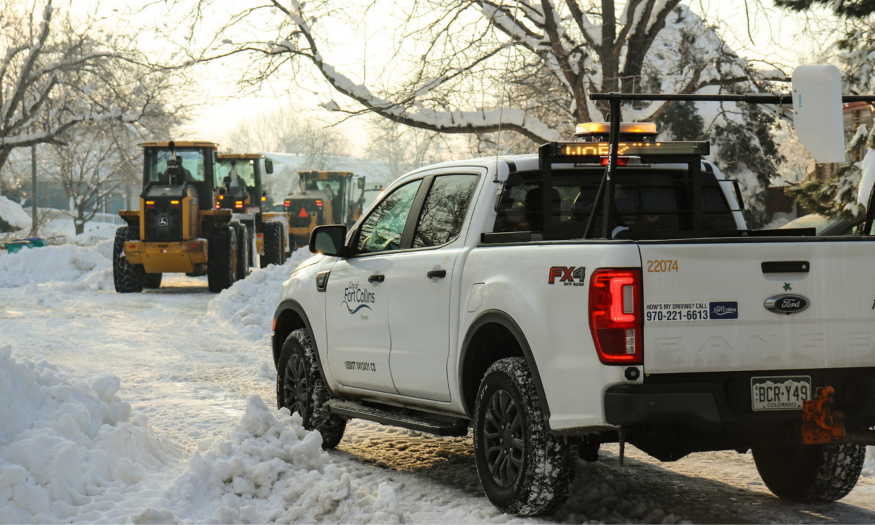
During and even after storm conditions, 20 snow plows are dispatched to cover eight snow routes throughout the city. Two to three snow plows are assigned to each route, covering an average of 67 lane miles per route of Priority 1, 2 and 3 streets. Snow plows are in operation 24 hours a day to achieve safe driving conditions for all Priority streets.

Priority 1 streets (major arterials) such as College and Prospect are addressed first. After these major arterials are adequately plowed and de-iced, then the operators move on to the collector or Priority 2 streets like Remington and Swallow that feed into the Priority 1 streets. Finally, Priority 3 streets including school areas, bus routes, and lesser used collector streets are plowed and de-iced.

Each storm presents different conditions, which warrant different approaches to snow and ice control. Factors such as the wetness of snow, pavement temperatures and ice build-up require operators to adjust their snow fighting techniques accordingly. During severe conditions, Priority 2 and 3 streets may be dropped to allow full concentration of Priority 1 streets.

Snow Emergencies
When storm conditions are severe, a Snow Emergency may be declared.  Factors such as wind and temperature combined with current and projected snow accumulations, influence this decision. When a Snow Emergency is declared, newspapers and local radio and televsion stations are informed in an effort to alert the public. All parked, stalled or abandoned vehicles may be towed from Priority 1 routes at the owner’s expense during Snow Emergencies. These streets (major arterials- College, Lemay, LaPorte, etc) are posted as “Snow Route Tow Away Zones.”  In severe weather conditions, residents are advised to avoid driving if possible.

snow sign
Watch out for Snow Plows
snow ice truck

Please use extra caution when driving near snow plows. Refrain from passing any snow plow until the plow vehicle stops or turns. If you do decide to pass, make sure there is a clear path to do so.

Visibility may be impaired by blowing snow or other winter conditions.  Avoid driving into a snow spray cloud that is created by the plow as this may cause a total “white out” of zero visibility to the driver.

Motorists should use extra caution when driving near specialized wing plows, which have a regular 12 foot plow in the front and a 9 foot wing plow that hangs to the right. This wing plowing system clears both the driving lane and shoulder lane or two lanes of traffic in one pass. This also means it can be extremely dangerous for motorists who try to pass the plow.

back to top

 
Additional Services
Ice Removal
ice-removalSometimes a heavy snow, a continued freeze/thaw cycle or excessive shade causes a dangerous build-up of ice along the sides of streets or at intersections. When this occurs, the Streets Department prioritizes these areas and posts “No Parking” signs along the street. A minimum of 24 hours later, the vehicles remaining in the no parking area may be towed at the owner’s expense in order for ice to be removed. Because of continual heavy ice buildup, Laurel Street west of College is permanently posted as a no parking area Wednesdays and Thursdays from 2:00am to 6:00am.
Downtown Snow Removal
Snow is generally removed from the downtown area between midnight and 8:00am, after the snow storm ends. Large, heavy equipment scrape snow and ice from the gutter and parking spaces and push it to the center of the street. From there, large snow blowers load the snow into dump trucks, which then haul the snow to designated dumping sites.
Sidewalk Plowing

Sidewalk PlowingThe Streets Department performs sidewalk snow removal along many sidewalks that are adjacent to Priority 1 arterial streets (such as Lemay, Drake, etc.). Because these sidewalks are positioned next to the curb on arterial streets, snowplows unavoidably deposit large amounts snow directly onto the sidewalk. When plowing operations have finished, a sidewalk snow removal crew will begin to remove snow from designated arterial sidewalks, using tractor and trackless machines. Fort Collins is one of very few Front Range cities to perform this service.

Businesses’ Responsibilities

Business owners and private contractors are strictly prohibited by City ordinance from pushing snow from private lots into the street or on public right-of-ways. Private contractors are often hired to provide parking lot and sidewalk snow removal for local businesses. Unfortunately many private contractors are unaware of the problems they can create. Snow from private property is often pushed into the street or public right-of-way, which typically extends to 5 feet behind the curb.

Such practices can block drainage or create a hazard on public sidewalks. Piled high enough, snow can block motorists’ views of oncoming traffic. When snow is pushed into the street, even temporarily, it can create a serious hazard for motorists and create liability for the business owner.

The exception to this rule is for businesses in the downtown snow removal area. These businesses are encouraged to shovel snow from their sidewalks into the street prior to the City’s downtown snow removal operations. This is the only instance when shoveling snow into the street is acceptable.

back to top

 
Sidewalk Snow Removal

Citizens are required by the City’s sidewalk snow removal ordinance to shovel their sidewalks adjacent to the public street within 24 hours of the end of a storm. Unshoveled sidewalks may be reported online to the Nuisance Hotline or by calling 416-2200. After a storm, Code Inspectors enforce the sidewalk snow removal ordinance, and hire snow removal contractors to correct sidewalk hazards at the property owner’s cost.

back to top

 
Snow FAQ's
Why doesn’t the City plow all streets?
There are big drifts on my street and I can’t drive down it. Can you do something?
There is a lot of ice build-up on the curb and gutters, and now it is forming over the sidewalk. Can you do something?
What does the City use to de-ice the streets?
Why not plow to the center of the street?
The plows have blocked my driveway with snow. Will you come and clear it?
The snow plows have covered my sidewalk with snow. Now what?

Can I park my car on a snow route?
My car was towed. Where is it?
I would like to volunteer to help an elderly or handicapped person shovel their sidewalk. What should I do?
My neighbors never shovel their sidewalk. What can I do?

Why doesn’t the City plow all streets?
The Streets Department maintains more than 540 lane miles of Priority 1, 2 and 3 streets. The remaining Priority 4 streets (residential streets) are plowed only when snow accumulation completely blocks traffic movement.
This is a rare occurrence in Fort Collins and is very costly to do. Priority 4 streets are not routinely plowed and de-iced because the lower traffic volume and traffic speeds do not typically warrant the expense. Additionally, because of the frequency of sunny conditions, there are few cities along the Front Range that routinely plow residential streets. The Streets Department will apply deicing materials on residential intersections on a case-by-case basis.

There are big drifts on my street and I can’t drive down it. Can you do something?
If large drifts present hazardous conditions, citizens should notify the Streets Department at 221-6615. Streets will be prioritized for plowing and deicing according to the severity of the problem.

There is a lot of ice-buildup on the curb and gutters, and now it is forming over the sidewalk. Can you do something?
Some streets in the City do not receive much direct sunlight, prohibiting a natural thawing of snow and ice. Consequently, ice build-up will block storm drains and create hazardous conditions if it forms over the sidewalk. The Streets Department will cut ice along severely affected streets after plowing operations have finished.

What does the City use to de-ice the streets?
The City uses a variety of environmentally safe deicing materials that help contribute to safe driving conditions.

  • Caliber M1000- this liquid product contains a blend of 30% Magnesium Chloride and corn. Caliber penetrates snow pack before it bonds to the pavement and it’s natural ingredient base is no more corrosive than water. 
  • Ice Buster- this complex chloride granular is pre-treated with Caliber M1000 to reduce corrosion while increasing deicing performance.
  • NC3000- this product’s corrosiveness is less than that of water, and is used primarily to deice bridges and concrete surfaces.

The City does not use 100% Magnesium Chloride or sand because of the detrimental effects to  air quality and to the environment. All City snowplows have Automated Vehicle Locators based on a Global Positioning System to track material usage and route information for enhanced productivity.

Why not plow to the center of the street?
Plowing snow to the center of the street can be very hazardous to motorists; traffic flow is restricted by eliminating a portion of a lane, the freeze/thaw cycle deteriorates the pavement, and icy driving conditions are created when the melting snow freezes on the pavement every night. This practice can also create sight obstructions for low vehicles, and cause problems for residents entering and exiting roadways. The Streets Department practices removing snow from curb to curb.

The plows have blocked my driveway with snow.  Will you come and clear it?
When you consider the large number of driveways in the city, it’s just too costly and time consuming to use additional people and equipment to perform this service. Our primary duty is to clear and keep open more than 540 lane miles of designated snow routes.

The snow plows have covered my sidewalk with snow. Now what?
The Streets Department will make every effort to clear sidewalks that have been covered by City plows at no cost to the property owner. Sidewalks that are plowed-over will be cleared by City crews or contractors. To report a plowed-over sidewalk, please call the Streets Department at 221-6615.

Can I park my car on a snow route?
Sure, but when snow begins to accumulate, we ask that you find an alternate place to park. This enables snow plows to remove all of the snow from the street, curb-to-curb, without having to swerve around parked vehicles. When plowing is completed, citizens may park their vehicles back on the street. Vehicles will be towed on posted Snow Emergency Routes only during a declared snow emergency, or if they are in violation of other parking restrictions. Snow Emergency Routes are posted on major arterial streets such as Mulberry, Lemay, Laporte, etc.

My car was towed. Where is it?
If the Streets Department is forced to tow your vehicle, you can call either the Police Department at 221-6540 or the Streets Department at 221-6615 to find out where your vehicle is located. Typically, vehicles are towed at the owner’s expense. Vehicles are impounded by a towing company and fees must be collected from the owner before the vehicle is released.

I would like to volunteer to help an elderly or handicapped person shovel their sidewalk. What should I do?
Great! We need more volunteers to help. Please call Neighborhood Services at 224-6046 to find out about the Adopt-a-Neighbor program. Or, you may choose to ask someone on your block if they might appreciate your help during snowstorms, and exchange phone numbers.

My neighbors never shovel their sidewalk. What can I do?
Residents are required by City ordinance to shovel their sidewalk within 24 hours of the end of a storm. If you are concerned about unshoveled sidewalks, please report it online to the Nuisance Hotline or by calling 416-2200.

back to top

Programs
Other Info